
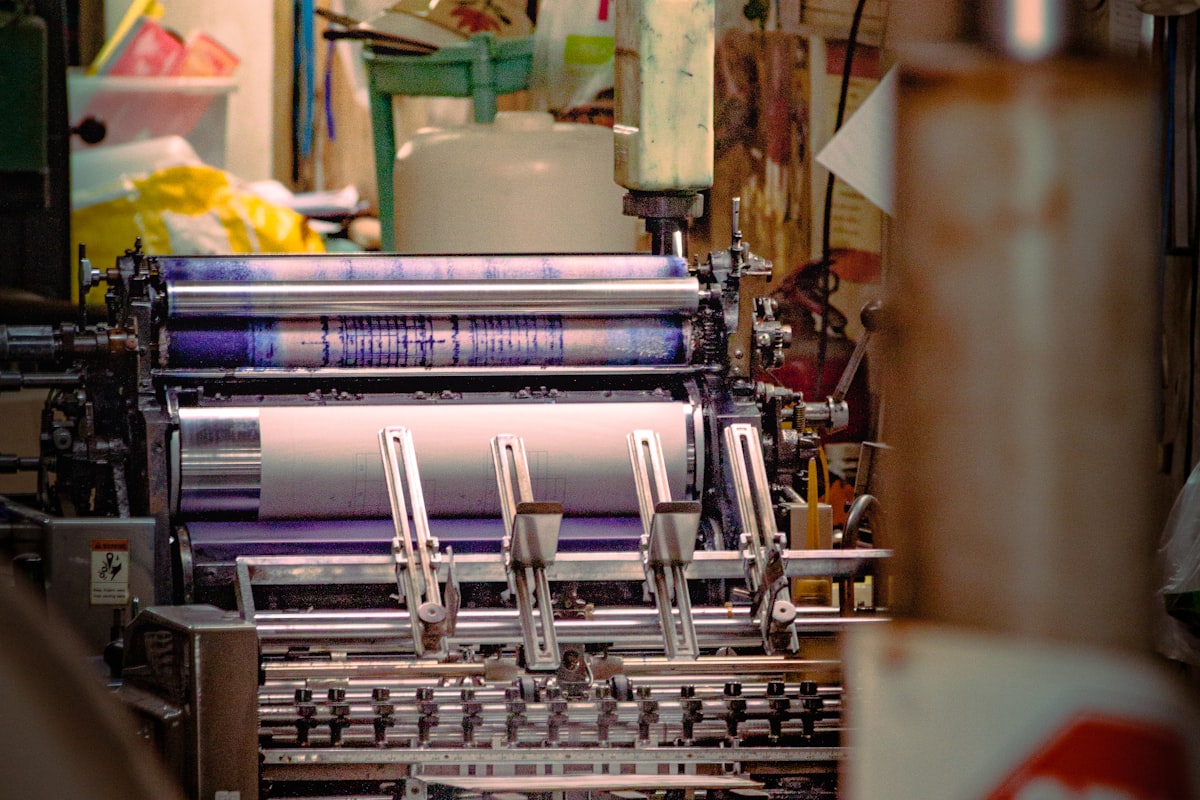
A flexographic press die-cuts, strips the waste matrix, and rewinds finished rolls in the same pass as printing — your label goes from blank material to applicator-ready in one trip through the machine.
Walk down any grocery aisle and most of the labels you see — water bottles, salsa jars, motor oil, shampoo — came off a flexographic press. Flexo is the workhorse of the label industry, and understanding how it works explains a lot about how labels are priced and why quantity changes everything.
How the process works
Flexography is a modern descendant of letterpress: a flexible polymer plate carries your artwork as a raised relief. The plate picks up a precisely metered film of ink from an engraved roller (the anilox), then stamps it onto the label material as it passes through the press at high speed. Each color gets its own station — its own plate, its own ink — and the material moves through all of them in a single continuous web.
A 6-station press can print six colors in one pass: for example four PMS spot colors, plus black for text, plus an inline UV varnish. After the last print station, the web continues into a rotary die that cuts the label shape, the waste matrix is stripped away, and finished labels are rewound onto rolls to your specification.
Why plates exist — and why reorders are cheaper
Each color in your design needs a physical plate made once, before the first run. That's the 'plate charge' on your first order, and it's why the first order of a new design costs more than a repeat. At GL Labels we store your plates, so exact reorders skip the charge entirely — one reason a consistent label spec pays off over time.
Where flexo wins
- Volume economics: once the press is running, cost per label falls steeply — runs of 10,000+ labels are where flexo shines
- Color consistency: PMS spot inks are mixed to formula, so your brand red is identical on every run
- Speed: thousands of labels per minute, with die-cutting and finishing inline
- Material range: paper, films (BOPP, PET), and thermal stocks all run on the same press
What it means for your quote
Two practical takeaways. First, quantity is your friend: plates and setup are fixed costs, so doubling a run rarely doubles the price. Second, color count matters: each additional color adds a plate and a station, so a 2-color design is meaningfully cheaper than a 6-color one at the same size and volume. If you're cost-sensitive, ask your label supplier how a small design simplification affects the run — the answer is often significant.
Put this into practice
Configure your exact spec — size, material, colors, quantity — and see a budget estimate in about 2 minutes. A specialist confirms final pricing within one business day.