
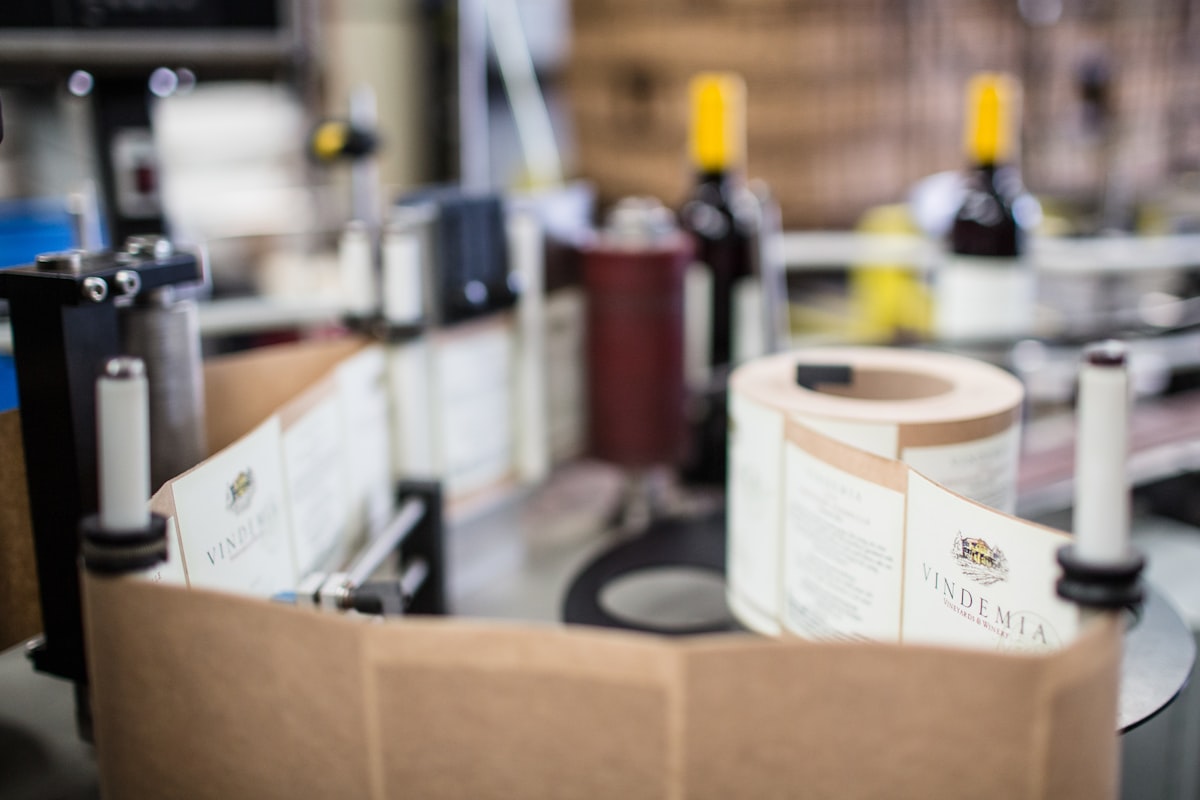
Your label consumes more material than its own footprint — the die gap around each label and the stripped waste matrix are part of every quote, which is why a small size reduction sometimes saves more than expected.
Ask five printers for a label quote and you'll get five numbers — but they're all built from the same ingredients. Understanding the structure turns you from a price-taker into a smart negotiator of your own spec.
The three ingredients of every label price
- Fixed setup: plates (one per color on flexo) and press make-ready. Identical whether you run 1,000 or 100,000 — which is why small runs carry a high per-label cost.
- Material: your label area plus die gap and waste allowance, times the facestock rate. Films cost more than papers; specialty stocks more still.
- Run cost: press time scales with total area printed and color count.
Why the per-label price falls so fast
Spread $300 of setup across 1,000 labels and it adds 30 cents each; across 100,000 it adds a third of a cent. That's the entire logic of volume pricing, and it's why the jump from 5,000 to 25,000 labels often costs far less than 5×. If your product sells steadily, an annual quantity on a blanket order — released in shipments as you need them — usually beats quarterly one-off orders on both price and availability.
Five levers that lower your cost per label
- Order more, less often — or set a blanket PO with scheduled releases
- Reduce color count: a 3-color design skips two plates and two stations versus 5-color
- Right-size the label: material is billed by area, and small trims compound at volume
- Standardize sizes across SKUs so multiple products share dies and setups
- Reorder exactly: repeat runs of an unchanged design skip plate charges entirely
One caution: don't optimize below your product's needs. A cheaper label that fails in the cold chain or fades on shelf costs far more than the savings. Get the construction right first, then use the levers above.
Put this into practice
Configure your exact spec — size, material, colors, quantity — and see a budget estimate in about 2 minutes. A specialist confirms final pricing within one business day.